Undergraduate Programs
Explore the programs offered by this organization.
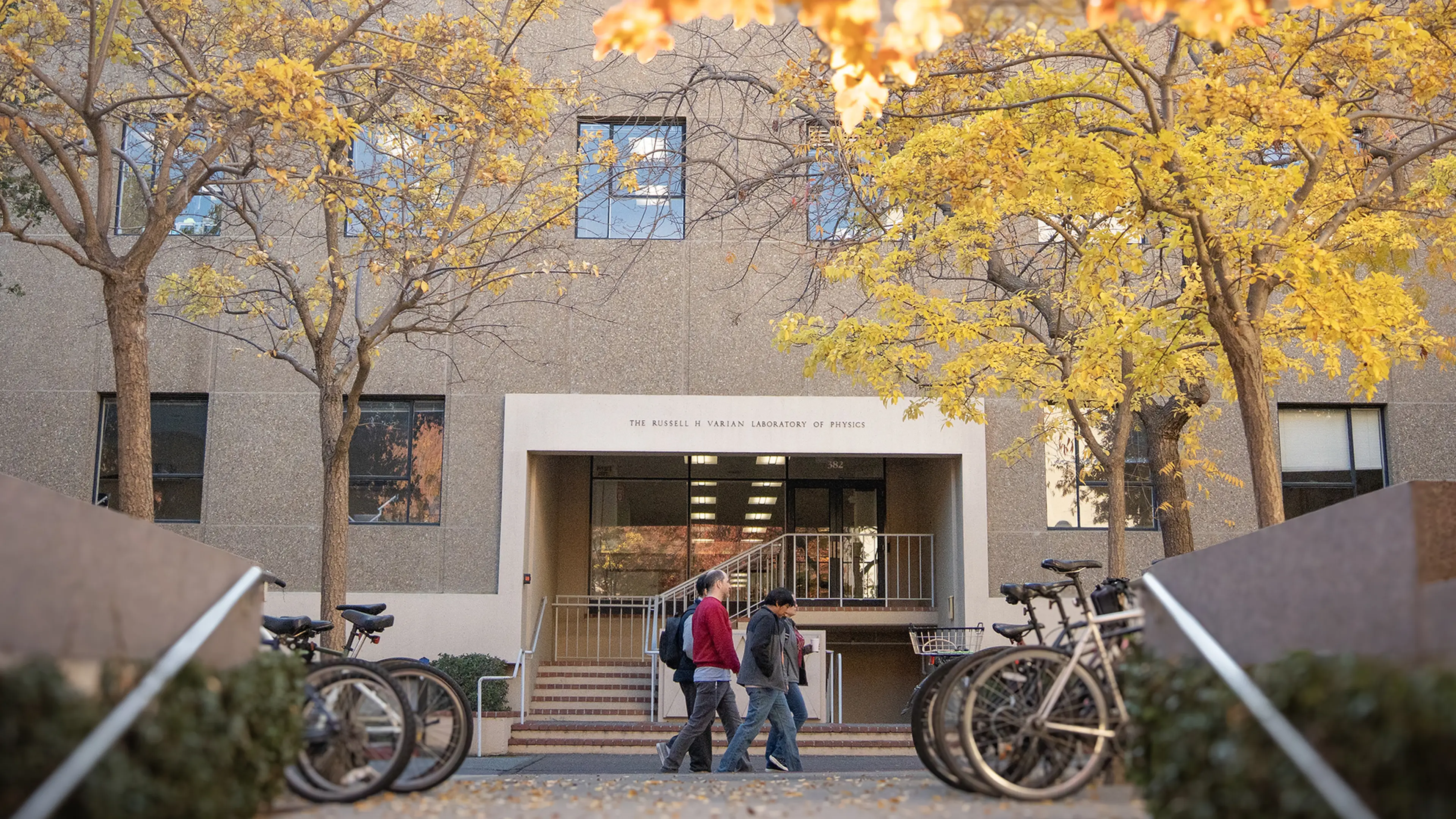
The Department of Physics provides students with a deep understanding of the physical principles that govern the universe that is grounded with a strong mathematical foundation. The program is designed to develop students' quantitative reasoning and problem-solving skills, as well as their ability to conceive experiments, analyze data, and interpret scientific results.
Whether pursuing physics as part of a general education, preparing for professional fields such as medicine or engineering, or training for a career in research and teaching, students acquire critical analytical abilities. The department prepares graduates for diverse career pathways across the public and private sectors, including teaching, research and development, medicine, law, science writing, science policy, and management in technical fields.
The Department of Physics offers comprehensive undergraduate and graduate programs designed to develop experimental competency and deep theoretical knowledge:
Undergraduate Programs (Major, Minor, and Honors): The Physics undergraduate program equips students with deep quantitative reasoning and problem-solving skills rooted in first principles. Designed to serve diverse goals—from satisfying science prerequisites and broadening scientific literacy to earning a major or minor in physics—our curriculum broadens students’ understanding of the universe at scales ranging from subatomic to cosmological. Undergraduates gain hands-on experimental experience in introductory and advanced laboratories. Prospective and declared physics majors are strongly encouraged to participate in research through the departmental summer research program. Physics majors have the opportunity to complete a senior thesis based on their research.
Graduate Program (Ph.D.): Our graduate physics program offers doctoral pathways designed to train future leaders across experimental and theoretical physics. Students conduct cutting-edge research ranging from quantum optics to particle physics and cosmology, supported by a vibrant campus community and advisors across multiple disciplines. Our scholars benefit from hands-on research at world-class facilities, including the SLAC National Accelerator Laboratory. Integrating rigorous coursework, research, and teaching experience, the program prepares graduates to expand human knowledge and achieve leadership roles in their scientific fields.
Physics research at Stanford spans a broad range of theoretical, experimental, and observational domains, supported by an exceptional network of on-campus laboratories, independent institutes, and national facilities:
Stanford Leinweber Institute for Theoretical Physics (LITP): Devoted to investigating theoretical physics spanning a wide range of areas including particle theory, quantum gravity, cosmology, quantum information, condensed matter physics, and biophysics. Members investigate topics such as the birth of the universe, the most elemental laws of physics, and the nature of materials.
SLAC National Accelerator Laboratory: A national laboratory funded by the Department of Energy hosting a two-mile-long linear accelerator, the Stanford Synchrotron Radiation Light Source (SSRL), and the Linac Coherent Light Source (LCLS)—the world's first x-ray free-electron laser. Research areas include photon science, accelerator physics, particle physics, astrophysics, and cosmology.
Kavli Institute for Particle Astrophysics and Cosmology (KIPAC): A joint institute with SLAC focused on using computational, experimental, observational, and theoretical approaches to understanding the Universe. KIPAC is heavily involved in major projects such as the Rubin Observatory Legacy Survey of Space and Time (LSST). Research programs at KIPAC include studies of dark energy and cosmic dynamics, structure and galaxy formation, the physics of inflation, dark matter searches and astrophysical signatures, interstellar medium physics, multi-messenger astrophysics, and investigations of black holes, compact objects, galaxies, clusters, the Milky Way, stars, and other astrophysical sources.
Ginzton Laboratory: Ginzton houses research on optical systems, quantum electronics, metrology, optical communication, and advanced lasers.
Geballe Laboratory for Advanced Materials (GLAM): Focusing on novel and nanopatterned materials such as high-temperature superconductors, magnets, and quantum dots. It houses the Stanford Nanocharacterization Lab (SNL) and the Center for Probing the Nanoscale (CPN).
Affiliated Independent Labs: Students and faculty frequently collaborate with the Center for Integrated Systems (focusing on electronics and nanofabrication) and the Clark Center (focusing on interdisciplinary biology, medicine, and bioengineering).