
Master of Arts
MACotermOverview
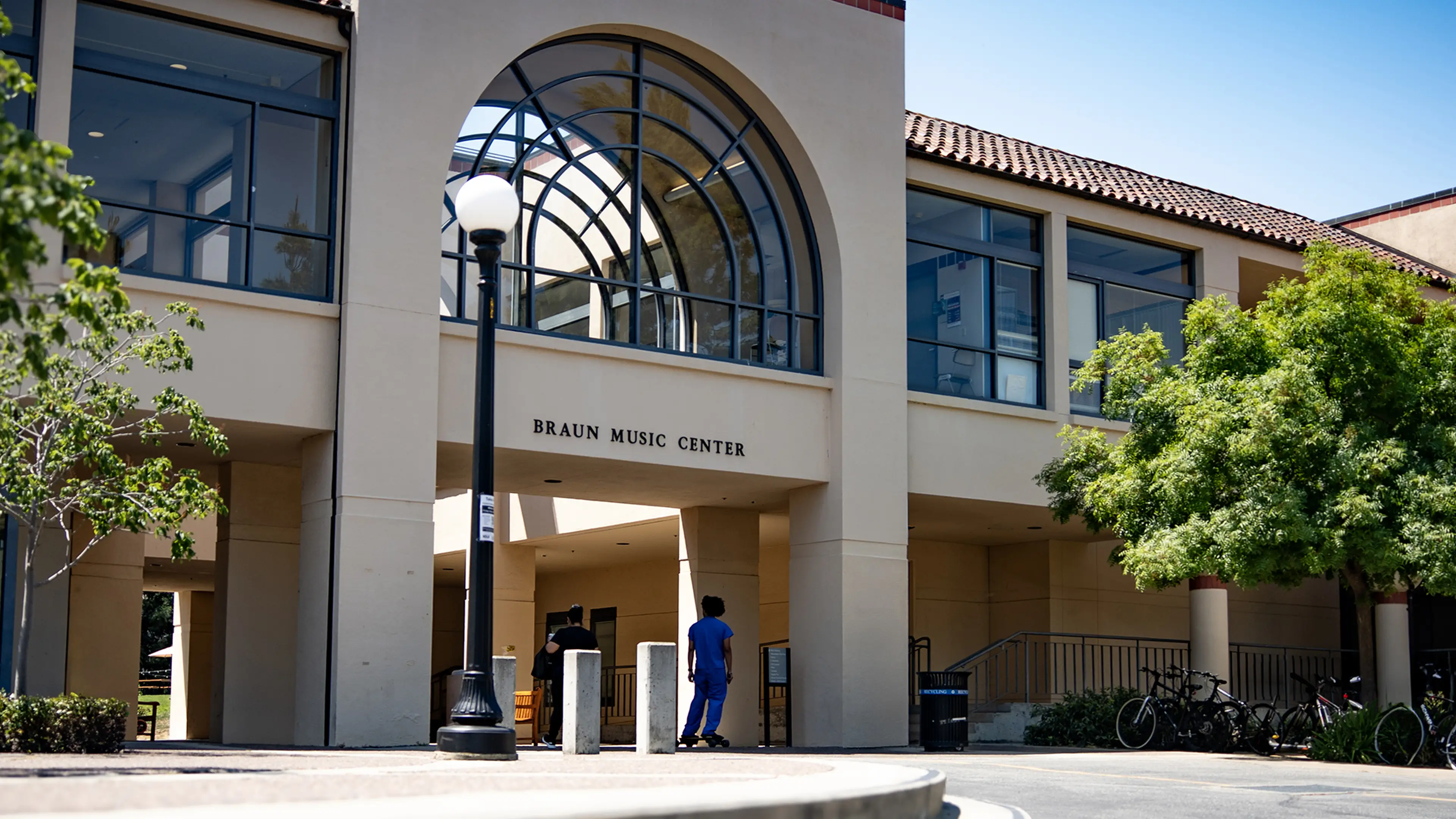
The Department of Music at Stanford combines music-making and scholarly research in composition, conducting, performance, music history, ethnomusicology, music theory, cognitive science, intermedia, and computer-based technologies. The Master of Arts (MA) in Music, Science, and Technology is the department’s only terminal master’s degree. This is a two-year program of 45 graduate-level units focusing on the integration of music perception, music-related signal processing and controllers, synthesis, performance, and composition. The program is designed for students who have an undergraduate music, engineering, or science degree.
Requirements
Program Requirements
Degree Options
All of the following fields of study are declarable as subplans in Axess via the “Declaration or Change to a Field of Student” form; they appear on the transcript and the diploma:
Master of Arts degree (MA) in Music—Composition subplan.
Master of Arts degree (MA) in Music—Music History subplan.
Master of Arts degree (MA) in Music—Ethnomusicology subplan.
Master of Arts degree (MA) in Music—Computer-Based Music Theory and Acoustics subplan.
Master of Arts degree (MA) in Music—Music, Science, and Technology subplan
The MA in Music, Science, and Technology is the department’s only terminal master’s degree.
Degree Requirements
A minimum of 45 academic units is required for a master’s degree in music. At least half of those units must be in courses with the career GR code (noted in the Bulletin); all must be at the 100-level or higher.
No course used to fulfill degree requirements for the BA in Music may be used to satisfy degree requirements for a graduate degree in music unless required explicitly for both degrees.
Only work that receives a grade of A, B, or S (a passing grade in an instructor-mandated credit/no credit course) in Music courses numbered 100 or higher taken as a graduate student is recognized as fulfilling the advanced-degree requirements.
Courses numbered 100 or higher taken as electives in other departments may be taken for credit or letter grade.
The expectation is that a student will be able to complete the required 45 units of coursework by the end of their second year.
Subplans
RequiredSubplan in Music, Science, and Technology
MST Required Coursework
MUSIC 201
CCRMA Colloquium
MUSIC 220A
Fundamentals of Computer-Generated Sound
MUSIC 251
Psychophysics and Music Cognition
MUSIC 256A
Music, Computing, Design: The Art of Design
MUSIC 320
Introduction to Audio Signal Processing
Units taken in required courses are determined in consultation with the student’s advisor.
Electives
The remaining units of graduate-level work are determined in consultation with the student’s advisor, must include three CCRMA electives, and may consist of courses taken outside the department.
MST Capstone Project
MA/MST students must complete a capstone project; they may fulfill this requirement by enrolling in 6 units in any combination of Music 298, 220c, and/or 220d, in which they work primarily towards their capstone. Capstone units must be spread between no less than two quarters; e.g., cannot take all 6 units in a single quarter.
The MA/MST capstone is intended to gather and focus skills acquired throughout the program toward an exploratory project to bridge your residency as a student and whatever will follow beyond your MA. For example, students interested in applied research might do design projects and/or mentored internships. For students considering going on to PhD research, the capstone can be considered a more flexible form of a master’s thesis, producing research and publication(s) that will strengthen your PhD application. For students wishing to continue in a DMA or another MFA program, the capstone can be the core of your creative portfolio. Mentorship can include your advisor augmented, should you choose, by any other faculty member from CCRMA or in other programs.
MUSIC 220C
Research Seminar in Computer-Generated Music
MUSIC 220D
Research in Computer-Generated Music
MUSIC 298
MA/MST Capstone Project
MST Coterminal Requirements
Coterminal master’s degree candidates are expected to complete all master’s degree requirements (as described in this Bulletin). Coterminal Master's Degrees describes university requirements for the coterminal master’s degree. Graduate Degrees describes the university requirements for the master’s degree.
After accepting admission to this coterminal master’s degree program, students may request transfer of courses from the undergraduate to the graduate career to satisfy the requirements for the master’s degree. Transferring courses to the graduate career requires review and approval of both the undergraduate and graduate programs on a case-by-case basis.
In this master’s program, courses taken during or after the first quarter of the sophomore year are eligible for consideration for transfer to the graduate career; the timing of the first graduate quarter is not a factor. No courses taken before the first quarter of the sophomore year may be used to meet master’s degree requirements.
Course transfers are not possible after the bachelor’s degree has been conferred.
The university requires that the graduate advisor be assigned in the student’s first graduate quarter even though the undergraduate career may still be open. The university also requires that the Master’s Degree Program Proposal be completed by the student and approved by the department by the end of the student’s first graduate quarter.
The required coursework is listed above. A complete program with an individually-tailored list of electives will be designed in consultation with the student’s advisor.
Subplan in Composition
Subplan Overview
Adding the MA to the doctoral program
A minimum of 45 academic units is required for the master's degree in Music. The M.A. in Music, Science, and Technology is the department's only terminal master's degree.
Students in the D.M.A. program in Composition and the Ph.D. programs in Computer-Based Music Theory and Acoustics, Musicology (Music History), and Ethnomusicology who enter with a Bachelor's degree may apply to add and be awarded the M.A. degree in their program at any time after completing 45 units of graduate coursework, passing the Qualifying Examinations, and advancing to Candidacy.
A doctoral student who has completed 45 units of graduate coursework in Music, but does not advance to doctoral candidacy, may petition for a terminal M.A. in their program. A terminal M.A in Composition, Computer-Based Music Theory and Acoustics, Musicology (Music History), and Ethnomusicology may be granted on an individual basis and at the discretion of the Music Academic Council faculty.
Subplan in Ethnomusicology
Subplan Overview
Adding the MA to the doctoral program
A minimum of 45 academic units is required for the master's degree in Music. The M.A. in Music, Science, and Technology is the department's only terminal master's degree.
Students in the D.M.A. program in Composition and the Ph.D. programs in Computer-Based Music Theory and Acoustics, Musicology (Music History), and Ethnomusicology who enter with a Bachelor's degree may apply to add and be awarded the M.A. degree in their program at any time after completing 45 units of graduate coursework, passing the Qualifying Examinations, and advancing to Candidacy.
A doctoral student who has completed 45 units of graduate coursework in Music, but does not advance to doctoral candidacy, may petition for a terminal M.A. in their program. A terminal M.A in Composition, Computer-Based Music Theory and Acoustics, Musicology (Music History), and Ethnomusicology may be granted on an individual basis and at the discretion of the Music Academic Council faculty.
Subplan in Computer-Based Music Theory and Acoustics
Subplan Overview
Adding the MA to the doctoral program
A minimum of 45 academic units is required for the master's degree in Music. The M.A. in Music, Science, and Technology is the department's only terminal master's degree.
Students in the D.M.A. program in Composition and the Ph.D. programs in Computer-Based Music Theory and Acoustics, History (Music History), and Ethnomusicology who enter with a Bachelor's degree may apply to add and be awarded the M.A. degree in their program at any time after completing 45 units of graduate coursework, passing the Qualifying Examinations, and advancing to Candidacy.
A doctoral student who has completed 45 units of graduate coursework in Music, but does not advance to doctoral candidacy, may petition for a terminal M.A. in their program. A terminal M.A in Composition, Computer-Based Music Theory and Acoustics, Musicology (Music History), and Ethnomusicology may be granted on an individual basis and at the discretion of the Music Academic Council faculty.
Subplan in History
Subplan Overview
Adding the MA to the doctoral program
A minimum of 45 academic units is required for the master's degree in Music. The M.A. in Music, Science, and Technology is the department's only terminal master's degree.
Students in the D.M.A. program in Composition and the Ph.D. programs in Computer-Based Music Theory and Acoustics, History (Music History), and Ethnomusicology who enter with a Bachelor's degree may apply to add and be awarded the M.A. degree in their program at any time after completing 45 units of graduate coursework, passing the Qualifying Examinations, and advancing to Candidacy.
A doctoral student who has completed 45 units of graduate coursework in Music, but does not advance to doctoral candidacy, may petition for a terminal M.A. in their program. A terminal M.A in Composition, Computer-Based Music Theory and Acoustics, Musicology (Music History), and Ethnomusicology may be granted on an individual basis and at the discretion of the Music Academic Council faculty.